Report structuring
Uploaded blood reports are transformed into structured biomarker records for review.
 EXIABIO
How Exia Bio structures biomarker intelligence, AI support, and controlled digital delivery without exposing public checkout or diagnostic claims.
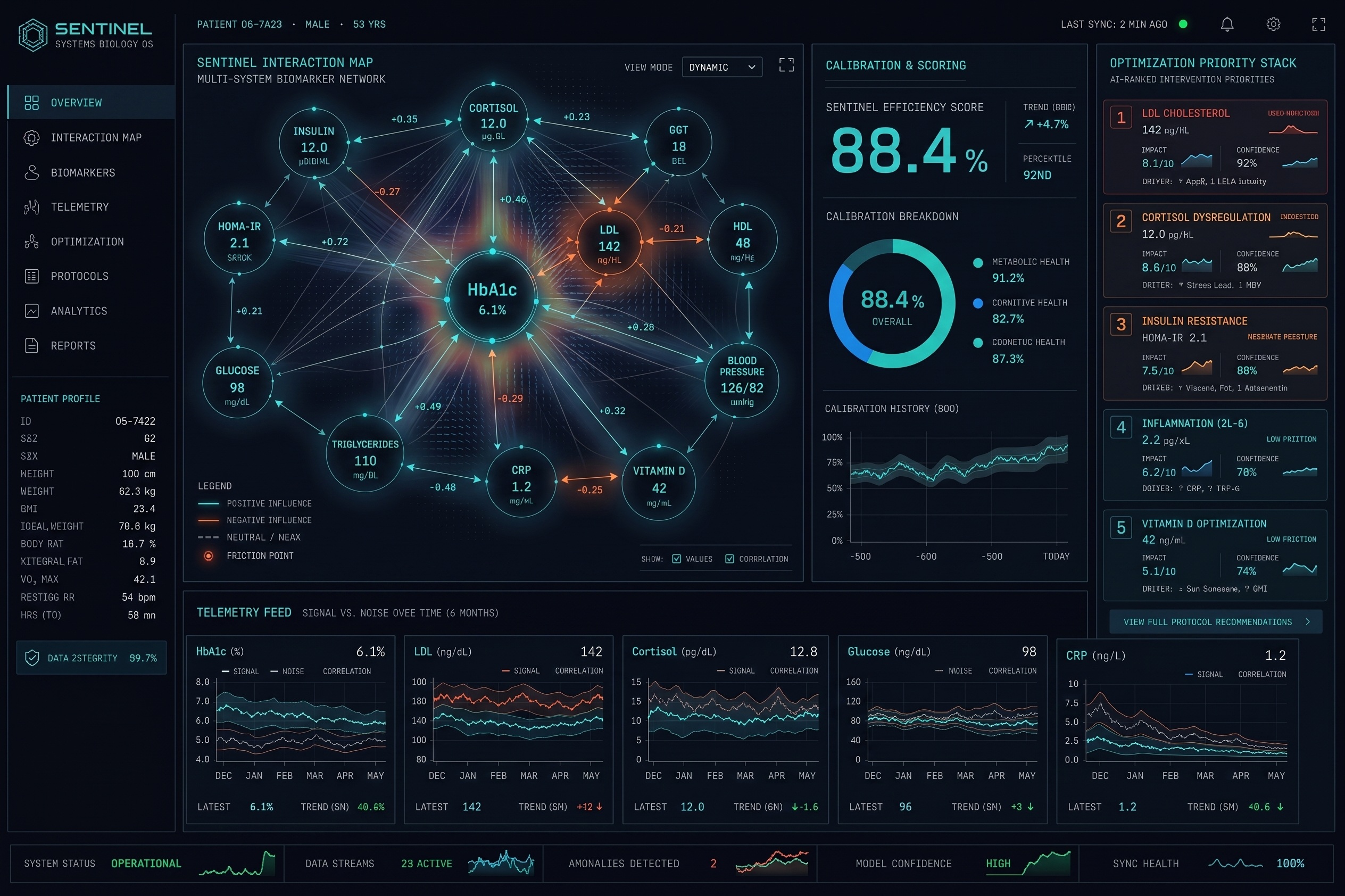
Report reality before Sentinel
Existing blood reports arrive with different formats, marker sets, lab conventions, and missing advanced signals. Sentinel starts by structuring this source context before any educational output is produced.
Illustrative report-context visual — not a Sentinel dashboard, customer interface, or final delivered report.
The AI layer supports report structuring, data normalization, missing-marker detection, and dashboard preparation. The Sentinel logic layer then organizes biomarker signals into pathway-specific output.
Uploaded blood reports are transformed into structured biomarker records for review.
Different report formats are converted into consistent internal records.
The system identifies gaps that limit confidence or require targeted follow-up.
Pathway logic and biomarker maps are prepared into dashboard-ready output.
This page is intended for high-intent users, partners, and technical reviewers who want to understand how Exia Bio is structured as a repeatable digital product.
01 · Intake
User submits report data, pathway selection, and relevant intake context.
02 · Structure
Values, units, dates, and reference intervals are converted into structured records.
03 · Interpret
Biomarkers are mapped into friction zones, missing signals, and pathway priorities.
04 · Deliver
Users receive a dashboard output designed for follow-up and future comparison.
Exia Bio is not presented as a consulting concept. The product is built around a repeatable workflow: uploaded report, structured data, biomarker logic, and dashboard delivery.
Evidence-to-output logic
01 · Report data
Existing lab values and marker availability
02 · Marker structuring
Tier 1 / Tier 2 grouping and missing-signal checks
03 · Confidence limits
What Sentinel can explain, and what remains incomplete
04 · Pathway calibration
Executive Performance, Training & Recovery, Metabolic & Body Composition, Longevity & Resilience, or System Awareness
05 · Output modules
Data clarity, performance zones, missing signals, and next priorities
Architecture view — internal report-to-output flow, not a dashboard screenshot.
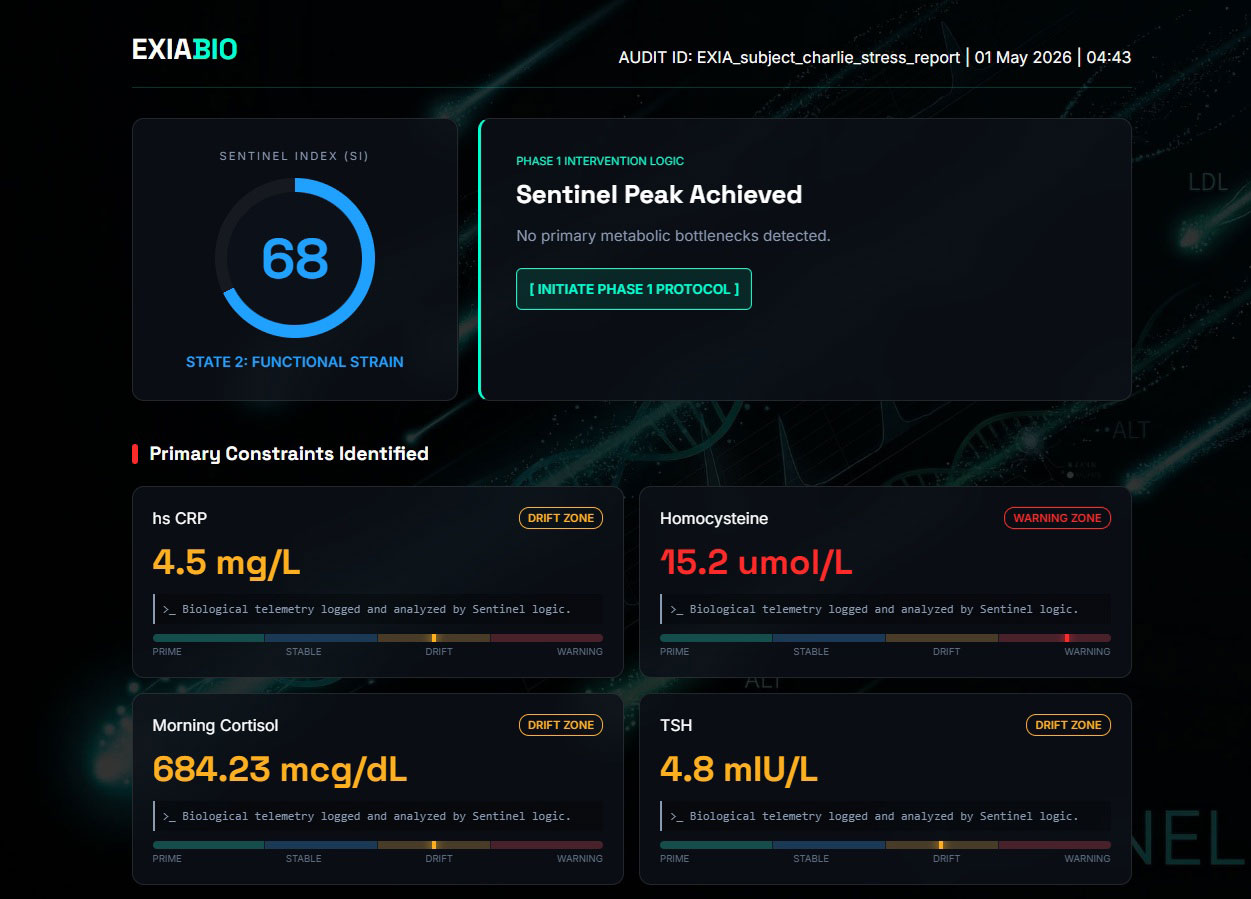
Dashboard Output
Current dashboard output preview showing Sentinel Index, constraint classification, and friction-zone logic.
Release Boundary
The platform remains non-diagnostic and educational. Where a result appears outside the context Exia Bio is designed to explain, users are directed to share their original laboratory report and Exia Bio dashboard with a licensed healthcare professional.
Exia Bio is being built from Singapore for SG/MY deployment. The operating model combines structured biomarker logic, AI-assisted processing, privacy-aware workflows, and quality-controlled dashboard delivery.
Exia Bio is designed to begin with controlled launch-stage operations, then expand automation, partner workflows, and continuity tracking as product evidence accumulates.
Manual review and controlled release help protect quality while workflows are validated.
AI-assisted structuring, rule checks, and dashboard generation can be progressively automated.
The same workflow can support regional product pages, partner channels, and continuity-based tracking.